
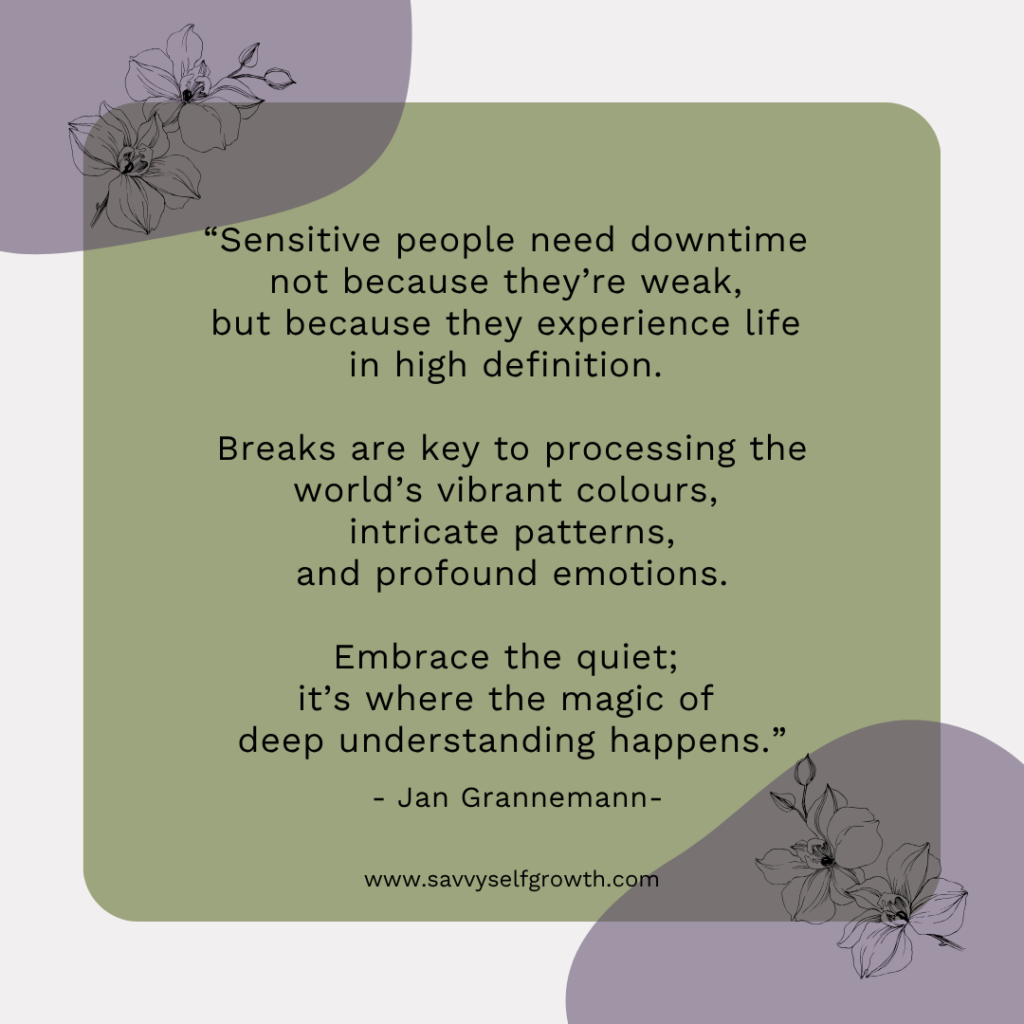
“Sensitive people need downtime not because they’re weak,
but because they experience life in high definition.Breaks are key to processing the world’s vibrant colours,
intricate patterns, and profound emotions.Embrace the quiet; it’s where the magic of deep understanding happens.”
– Jan Grannemann –
I hosted my fifth Gentle Reset Gathering on the theme of Managing Sensory Overload, and what unfolded was so relatable that I wanted to share some reflections and tools with you here.
Many of us who identify as Highly Sensitive Persons (HSPs) (or simply as gentle souls who feel deeply) know how easy it is for our systems to become overstimulated in our fast-paced world. Yet so often, we judge ourselves instead of listening to what our bodies and minds truly need.
Understanding Sensory Overload
Research suggests that around 20–30% of the population is wired with a more sensitive nervous system.
That means our brains and bodies process everything more deeply: sights, sounds, smells, emotions, sensations in our own bodies, even subtle shifts in other people’s energy. It’s not a flaw or a weakness; it’s simply how we’re designed, like some people have blue eyes and others brown.
Because we notice so much, our systems can reach “full capacity” sooner than others’.
I usually start feeling frazzled after too much noise, too many conversations, crowds, or even a long day of emotional caring. I experienced this several times while at my mom’s in South Africa. She has had Parkinson’s for 14 years, and it’s a really intense 6 weeks when I’m there.
When that happens, it’s easy to think “What’s wrong with me?” and feel bad about not being able to handle what I think I should be able to.
The truth is — nothing is wrong. My nervous system was simply saying, “Too much input — I need a pause to process it all.”
Too Many Open Tabs
Sometimes our sensitive system is a bit like a computer.
It’s brilliant at processing — noticing the small details and subtle layers of what’s happening around us. But when too many tabs are open, even the best computer slows down or freezes. It doesn’t mean anything’s wrong; it just needs a minute to close a few tabs or even reboot if it’s too bogged down.
Or we might compare it to a lush garden after a heavy rain. The rain itself is nourishing and brings life. However, when there’s too much, too fast, the soil and roots become waterlogged and can’t take in any more. They need time for the excess to drain, for sunlight to return, and for balance to be restored.
The solution isn’t to wish for a tougher system or a different garden, although of course I’ve heard from so many of my sensitive clients over the years: “I wish I were different, more like my brother-in-law. I wish I could handle more. I feel inadequate.”
And to be honest, I’ve had similar desires in the past… especially before I knew about different sensitivity levels.
However; I’ve also noticed that longing for a different nervous system isn’t useful and unfortunately doesn’t change a thing. That’s a sure road to ‘comparison-itis’ and more of ‘There’s something wrong with me’.
What works better, I’ve discovered, is to give ourselves permission to be who we are, and allow what’s beautiful and sensitive within us to reset in its own gentle way.
The Hidden Layer: Beliefs That Block Self-Care
In my own life, I’ve noticed how I end up feeling scattered, frazzled, tearful, or disconnected from myself if I ignore the early signs of overload. Almost like I’ve lost my anchor and am adrift at sea.
One day during a visit to my mom, I ended up in a coffee shop (hello, Mugg and Bean, Shelly Mall!) crying and tapping (EFT) — because I neglected giving myself a break when I noticed the red flags.
It really is important to do something about it the moment we notice. The weird thing is, sometimes we don’t (or can’t) for hidden reasons.
During the recent HSP Gathering, we explored how much harder it can be to care for our nervous system when old beliefs get in the way.
Five Beliefs
Here are a few I shared that might be in the way for us. And then some compassionate ways to reframe them.
“I should be able to cope better.”
Reframe: I’m learning to notice my limits with kindness. It’s okay to pause, rest, and care for my sensitive system — that’s wisdom, not weakness.
“I’m too sensitive / I overreact.”
Reframe: My sensitivity is not ‘too much’; it’s part of how I connect deeply with life. I can honour my emotions as information, not as flaws.
“I have to keep everyone happy.”
Reframe: I can care about others without carrying their feelings. It’s safe to prioritise my peace and let others have their own experiences.
“If I slow down or take space, people will think I’m selfish or lazy.”
Reframe: Rest and stillness restore my clarity and presence. When I recharge, I can bring my best self to those I care about.
“Something must be wrong with me — other people seem fine.”
Reframe: There’s nothing wrong with being finely tuned. My sensitivity is a gift that allows me to see, feel, and respond with depth and compassion.
Which one(s) do you identify with most?
What Helps When Everything Feels “Too Much”
Once we recognise the signs of overload and soften our self-talk, the next step is to gently give our system a break, like restarting our computer or closing tabs.
During our Gathering, I asked participants what helps them in those moments. Their responses were such beautiful reminders that healing can be simple, personal, and deeply human… small acts of kindness to ourselves that can restore balance.
Here are some of their lovely suggestions:
- Find something to focus on — a book, a part of nature, making art
- A nice nap
- Self-compassion (“I acknowledge how hard this is for me, and it’s okay that it’s hard. I’m human too.”)
- Be careful not to overbook the day; humming; walking in grass
- Walking just to walk
- Let myself off the hook — remind myself I don’t have to always perform
- Go outside and listen to the birds
- Create an energetic bubble and give myself permission to just be
- Do a bit of tidying up to make my home feel safer
- Eat sweets without guilt
- Watching clouds drift by
Each one of these is a form of nervous system care. It’s a way of saying, “I matter enough to slow down and decompress.”
A Gentle Tapping Invitation
If you enjoy using EFT (Emotional Freedom Techniques), here’s a simple tapping sequence you might try the next time you feel overloaded:
Tapping on the side of the hand, while saying:
Even though my system feels full right now, I honour how much I’ve been processing. It’s okay to pause and breathe.
Even though I wish I could handle more, I choose kindness instead of pressure. My nervous system is wise, and I’m listening.
Even though part of me feels guilty for needing rest, I’m learning that slowing down is how I come home to myself.
Then, tap through all the face, body and finger points while you talk through how you think, feel and experience life currently. For instance:
All this overwhelm
Everything feels too much
I’m frazzled
I’ve lost my anchor
My system feels full
I wish I could handle more, but I can’t
I feel guilty for needing rest
I wish I could handle more
And so on. Simply say what is true for you. Or, just tap in silence, noticing your body sensations. You will likely start feeling a ‘settling’ as you tap through your sensations, emotions, and thoughts. After a few rounds, take a deep breath. Feel your feet, your seat, your breath, and notice what begins to lift.
If you want to do this with an online tapping partner, visit my free Insight Timer audio here:
Too Much, Too Fast: EFT Tapping For Overwhelm | Liesel Teversham
In Closing
Realistically, for sensitives as well as non-sensitives, there truly is too much coming at us from all sides in the 21st century.
A hundred years ago, we knew what was going on for our immediate family, plus a few people in the village. Letters were handwritten, and took weeks to be delivered.
Now, the entire globe’s distressing news is on our phone screen, and we have 100 or (6,000 if you’re my husband) emails, drumming their fingers in your inbox.
The landscape has completely changed, yet our nervous systems have not yet evolved to match the unbelievble amounts of input.
If you’re a sensitive soul, you don’t need to toughen up to thrive. You really do need to tend to your sensitivity with care and respect.
Every pause, boundary, or moment of breathing space is a way of affirming: My wellbeing matters. My sensitivity is a strength.
When you respect your sensitive system, it stops feeling like a burden and becomes a beautiful gift that makes the world a kinder place.
How will you care for yours?